

A note for all License Holders: This blog post is part of a larger series on popular hymn tunes in the public domain. Remember that the texts paired with these melodies may be copyrighted. In those cases, the text copyright holder’s permission would be needed to use the copyrighted text, even if the melody is in the public domain. Be sure to search and report these copyrighted texts through your ONE LICENSE account.
A note for our License Holders in Australia and New Zealand: In these regions, publishers earn a royalty on their engraving of musical works. During the reporting process, License Holders will be prompted to select the publication source they are using.
ONE LICENSE offers a Sacred Sounds podcast where you can learn more about sacred music, old and new. To listen to all episodes of Sacred Sounds, visit https://media.rss.com/sacredsounds/feed.xml (or please click here).
In our continuing series, Utilizing Public Domain for Your Ministry, this month’s tune WONDROUS LOVE is a relative newbie, at least in public domain hymnody terms. It comes to us from the New World, a creation of North American folk hymnodists, specifically those of the Carolina shape-note singing tradition. Though many of us associate the tune with the text, “What Wondrous Love Is This,” the tune alone is known by the shorter identifier, WONDROUS LOVE.
The Carolina shape-note singing tradition is part of a centuries-old music education system called “fasola” singing. Fasola singing gets its name from the vocal syllables used to represent each note of the scale. Fans of The Sound of Music are familiar with the solfege system, where the eight notes of each scale are “Do-Re-Mi-Fa-So-La-Ti-Do.” Fasola singing simplifies the scale, making it easier to teach by replacing those syllables with only four: Fa-So-La-Fa-So-La-Mi-Fa. This four-syllable scale is an efficient teaching tool because it helps singers to memorize where the half- and whole-steps of each scale are without learning key signatures.
Traveling choir masters, who focused on metrical psalmody, initially spread the practice of fasola singing throughout England during the 17th Century. Though fasola singing fizzled out in England during the 18th Century due to the rise in compulsory music education, singers in the States (mainly in the South) have kept the practice of fasola singing alive through the present day.
Shape-note notation is a way of representing the fasola system visually: each syllable is represented by a different shape on the musical staff (see Example 1 below). Whenever singers see a diamond-shaped note, they know to sing “mi”; when they see a triangular note, they know to sing “fa”; and so on.
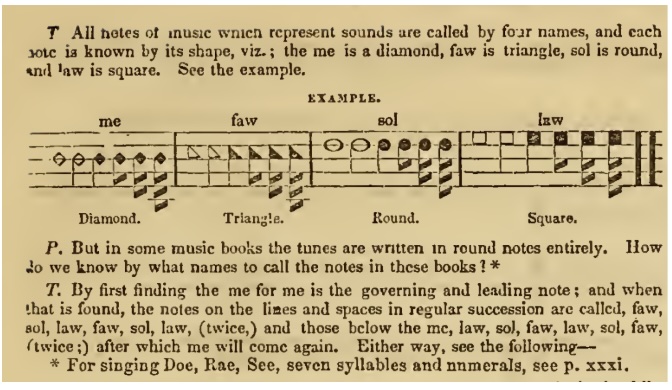
Shape-note notation and the singing groups who employed it took root in the United States during the early 19th Century. This singing method became popular in America at roughly the same time that Anglo-Americans were settling farther south and west. We can trace a progression of shape-note publications from the northern Appalachians in Pennsylvania, through the Shenandoah Valley, on to Virginia, Georgia, Missouri, and westward from there. Publishers of shape-note collections compiled folk hymns that had been passed on through oral tradition; the publishers then edited and harmonized these folk tunes to create elaborate hymn settings. Shape-note hymns are always written in three- or four-part harmony, with the melody in the tenor. It may be surprising for modern singers to see the melody in tenor rather than the soprano (or top voice) where we would normally expect the melody to be today.
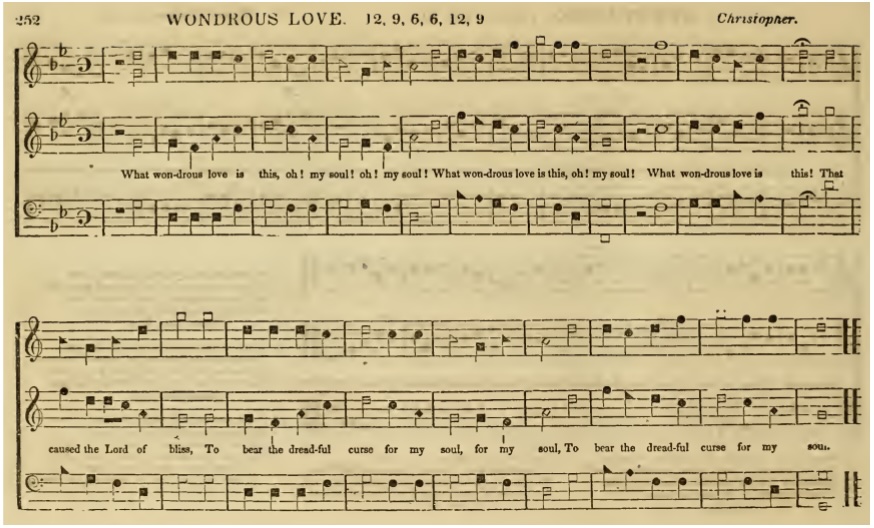
See Example 2 below for the original print setting of WONDROUS LOVE. Notice that the melody appears in the tenor part, the middle of the three lines.
Shape-note singing proliferated among Southern camp revival meetings. These meetings centered around musical evangelization, and shape-note singing was a popular way to participate in group devotion. The spread of shape-note singing was slowed by the outbreak of the American Civil War in 1861. The two most popular shape-note publications, almost universally known among shape-note singers, are William Walker’s The Southern Harmony (1835) and Benjamin Franklin White and E.J. King’s The Sacred Harp (1844). The latter volume is so successful that the Sacred Harp Society still publishes new editions and hosts conventions to promote research and use of this repertoire.
In subsequent decades, the shape-note repertoire survives through special events called “singings.” These gatherings are not sacred worship but secular and informal social gatherings where crowds of singers meet to sing from shape-note collections. Shape-note singing is a democratic medium in the sense that all singers are expected to participate equally. Members take turns choosing and leading songs; there is no single conductor, no matter how large the group is. Rather than standing arrayed shoulder to shoulder as a formal choir, the singers form the outline of a square, with each side of the square comprised of a different voice part (soprano, alto, tenor, or bass). Shape-note singers employ an idiomatic style, similar to country-western and folk singing. The singing is nasal and as loud as possible, without vibrato but with bent pitches (i.e., “scooping” in and out of notes). Most shape-note singing is a cappella, and these singers usually like fast tempos.
WONDROUS LOVE first appeared in Walker’s The Southern Harmony as one of the folk hymns passed down through oral tradition among the Carolina singing school. Keep in mind that this “school” was not an academic institution but a group of like-minded artists who shared and produced music with each other. James Christopher, a shape-note singer and teacher based in Spartanburg, South Carolina, arranged WONDROUS LOVE as it appears in The Southern Harmony. However, we do not know who invented the tune or how it may have evolved over time. Christopher’s arrangement was for three voices, with the melody appearing in the middle voice. Interestingly, when White and King included the tune in The Sacred Harp, they incorporated an alto line composed by S.M. Denson, so we see a four-voice arrangement in that publication.
Regardless of arrangement, WONDROUS LOVE is a more challenging tune than others we have discussed, showcasing the skill of shape-note singers. The range is a little over an octave. The melody does not move by stepwise motion up and down the scale; rather, it arpeggiates various chords, skipping from one note of the chord to the next. Because WONDROUS LOVE is in minor mode, the tune may feel less natural to casual singers. In minor mode, the third, sixth, and seventh scale degrees are lowered to produce a more somber effect. Referring back to The Sound of Music, this means that “Mi,” “La,” and “Ti” are replaced by notes that are each a half step lower. While many musicians associate “somber” with “slow,” shape-note singers tend to reject that association and sing WONDROUS LOVE at a brisk pace.
Perhaps most challenging of all is the form of WONDROUS LOVE, which consists of an eight-measure phrase, a four-measure extension of that phrase, and a repetition of the eight-measure phrase. Though the tune begins and ends with an identical phrase, the four-measure interjection can unbalance singers who are not prepared for it. The words - at least of the original “What Wondrous Love Is This” text - are also different during the repetition of the eight-measure phrase, which may also unsettle singers unfamiliar with the tune or text.
WONDROUS LOVE is an excellent example of a revered and living cultural patrimony in North America. Though it exemplifies a history rooted in the folk singers of the Carolinas, the melody is timeless and brings beauty to worship in all ages.
Photo by Pixabay: https://www.pexels.com/photo/empty-bench-at-a-garden-161064/
